Investopedia
Best broker for low costs
Investopedia's yearly broker awards have named Interactive Brokers best in class for costs and for international trading, which are the two points that matter most from Switzerland.
Read the sourceThe Smart and Swiss Investor · Updated 2026
I invested through one of the big Swiss banks from my teenage years on. Then I read a pile of books, did the maths and three years ago I moved everything to Interactive Brokers. This page is what I wish somebody had put in front of me back then: what an account really costs from Switzerland, how safe the money is, what independent reviewers say, and what the pros and cons of IBKR are.
Referral link: ibkr.com/referral/marco1592. The bonus is paid by Interactive Brokers. Using it costs you nothing extra.
Why this page exists
I opened my first securities account as a teenager at one of the big Swiss banks. It felt safe and grown-up: a familiar name, a friendly advisor, a statement in the letterbox every quarter. For years I never questioned any of it.
Then I started reading. "Rich Dad Poor Dad" got me thinking about money in the first place, and Gerd Kommer's books on index investing taught me what to actually look at: total cost, diversification, and how much of the return the bank keeps. After that I went through my own statements line by line.
What I found: a custody fee every quarter, a fat margin on every currency exchange, a commission on every trade, and in-house funds that did worse than the index they were tracking. I was paying extra for below average results.
Three years ago I stopped. I moved the portfolio to Interactive Brokers and my yearly cost of investing dropped to a fraction of what it was, with the same investments inside. Everything below is the homework I did before that move, so you can redo it yourself.
What independent reviewers say
I am one investor with one opinion. These are established, independent sources that test brokers systematically every year. Each link goes to the source so you can read the current edition yourself.
Investopedia
Investopedia's yearly broker awards have named Interactive Brokers best in class for costs and for international trading, which are the two points that matter most from Switzerland.
Read the sourcemoneyland.ch
Switzerland's best-known independent comparison service prices the same portfolio at every broker available here. Interactive Brokers comes out at the bottom of the cost table.
Read the sourceExample Portfolio: CHF 50,000 to start, CHF 500 a month, 5% a year, over 30 years. Interactive Brokers costs CHF 614 in total fees. This is what every other broker available in Switzerland charges for exactly the same thing. Disclaimer, up to 74 times more!
| Broker | Fees over 30 years | You pay extra vs IBKR | IBKR is |
|---|---|---|---|
| Interactive Brokers | CHF 614 | nothing | the benchmark |
| Saxo Bank | CHF 2'900 | CHF 2'286 | 5x cheaper |
| PostFinance | CHF 3'900 | CHF 3'286 | 6x cheaper |
| Yuh | CHF 3'900 | CHF 3'286 | 6x cheaper |
| neon | CHF 5'600 | CHF 4'986 | 9x cheaper |
| Swissquote | CHF 8'100 | CHF 7'486 | 13x cheaper |
| Cornèrtrader | CHF 10'500 | CHF 9'886 | 17x cheaper |
| VIAC Invest | CHF 19'600 | CHF 18'986 | 32x cheaper |
| Zak Invest | CHF 24'000 | CHF 23'386 | 39x cheaper |
| Raiffeisen | CHF 25'200 | CHF 24'586 | 41x cheaper |
| UBS key4 | CHF 38'000 | CHF 37'386 | 62x cheaper |
| ZKB | CHF 45'245 | CHF 44'631 | 74x cheaper |
Rankings are re-published each year and can change. I have no relationship with any of these publications; check the linked page for the latest edition and the exact wording of each award. Fee figures are the moneyland.ch style comparison for the portfolio described above and are rounded.
Refer a Friend
Interactive Brokers runs an official Refer a Friend programme. When you open your account through an invitation link, IBKR credits you IBKR stock based on what you deposit and keep in the account. Not a gimmick voucher, but real shares of the listed broker.
IBKR owns and can change these terms at any time. The exact, binding conditions are displayed on the invitation page before you sign up, so read them there.
Is Interactive Brokers safe for Swiss residents?
01
Interactive Brokers Group operates through regulated entities: IB LLC in the US (SEC, FINRA, CFTC) and IBKR Ireland (Central Bank of Ireland), among others. Swiss residents are assigned to one of these entities during onboarding. The account documents tell you which one, and that determines your protection scheme.
02
Client securities are held in segregated custody accounts, separate from the broker's own balance sheet. In an insolvency, segregated client assets are not part of the estate available to the broker's creditors. Swiss custody law works on the same principle.
03
Accounts at IB LLC are covered by SIPC up to USD 500,000 (max USD 250,000 cash), plus supplemental insurance. Accounts at IBKR Ireland fall under the Irish investor compensation scheme (90% of the claim, capped at EUR 20,000). These schemes cover broker failure, never market losses.
04
IBKR Group is listed on NASDAQ, publishes quarterly audited accounts, carries no long-term debt and holds equity far above regulatory minimums. Automated real-time margin liquidation keeps client-default risk low, which is unglamorous but genuinely matters.
05
You are a client of a foreign broker. There is no Swiss deposit protection (esisuisse covers bank deposits, not securities), no Swiss e-Steuerauszug, and correspondence is in English. That is the honest trade-off for the lower costs.
06
Uninvested cash at a broker is a claim on that broker, not a bank deposit. Many Swiss investors keep only working cash at IBKR and stay invested in ETFs, which are held in custody rather than on the broker's balance sheet.
Costs
For a Swiss buy-and-hold ETF investor, three items dominate the lifetime cost: custody fees, currency conversion and stamp duty. IBKR is structurally cheap on all three. Figures below are indicative, so always verify on ibkr.com and at your own bank.
| Cost item | Interactive Brokers | Typical Swiss bank / broker |
|---|---|---|
| Custody / Depotgebühr | None | Often 0.1–0.4% p.a. at Swiss banks |
| Swiss stamp duty (Umsatzabgabe) | Not charged (foreign broker) | 0.075% / 0.15% per trade |
| ETF trade, US exchange | From USD 0.35 (tiered) | CHF 5–30 typical |
| ETF trade, SIX Swiss Exchange | From ~CHF 1.50 (fixed tier) | CHF 5–20 typical |
| CHF → USD conversion | ~USD 2 per conversion, near interbank rate | 0.5–1.5% spread is common |
| Interest on idle cash | Near benchmark rate above a threshold | Usually 0% |
| E-Steuerauszug | Not provided (activity statement instead) | Usually included, but often CHF 50–100 extra |
you invest regularly in globally diversified funds, hold a six-figure portfolio or plan to, convert CHF to USD or EUR, want US domiciled funds and the DA-1 route for US withholding tax, and you are comfortable filling in your Swiss tax return from an activity statement.
you invest a few hundred francs a month, want an e-Steuerauszug and German-language support, or you value a domestic counterparty more than roughly 0.2–0.5% a year in costs. Yuh, neon invest, Swissquote and Saxo are the usual alternatives.
A worked example
Same fund, same amount of money, same year. One investor holds CHF 100,000, buys CHF 1,000 of a world ETF every month and changes CHF 12,000 into dollars once. The only difference is where the account sits.
| Over one year | Interactive Brokers | UBS securities account |
|---|---|---|
| Custody fee on CHF 100,000 | CHF 0 | ≈ CHF 300 (0.30% a year) |
| 12 ETF purchases of CHF 1,000 | ≈ CHF 12 (from USD 0.35 a trade) | ≈ CHF 480 (CHF 40 a trade) |
| Swiss stamp duty on those purchases | CHF 0 | ≈ CHF 18 (0.15%) |
| Changing CHF 12,000 into USD | ≈ CHF 2 at the market rate | ≈ CHF 120 (about 1% spread) |
| Total for the year | ≈ CHF 15 | ≈ CHF 920 |
That is roughly 0.9% of the portfolio handed back to you for doing nothing differently. Leave those savings invested at 6% a year and after twenty years it is over CHF 30,000, on this one portfolio alone. A larger portfolio saves more, because the custody fee grows with it and the IBKR side barely moves.
Every Swiss broker, same portfolio
Start with CHF 50,000, add CHF 500 every month, assume 5% a year. Depending on where you keep the account you pay somewhere between CHF 614 and CHF 45,245 in fees over those 30 years. Same fund, same money, same market return. Only the provider changes. Want to play around with your own numbers? Use the broker fee calculator on etfschweiz.ch.
That is the difference between the cheapest and the most expensive account, about CHF 1,488 a year.
Fees you never pay stay invested. CHF 42,044 of that extra money is pure compounding on the savings.
At the Swiss banks it is mostly the yearly custody fee, not the trading. It is charged whether the market goes up or down.
If you want one fund and nothing else
If convenience matters more to you than optimising the last few basis points, buy the whole world in one line. The Vanguard Total World Stock ETF, ticker VT, holds roughly nine thousand companies across developed and emerging markets, from Nestlé and Roche to Apple and Samsung. Large, mid and small caps are all in there.
You never have to decide how much America, Europe or Asia to own, and you never have to rebalance between funds. The index does it for you as the world changes. Vanguard charges 0.06% a year, so on CHF 100,000 that is about CHF 60. At Interactive Brokers a purchase starts at USD 0.35, which means a monthly CHF 1,000 buy costs you a rounding error.
Two honest caveats. VT is domiciled in the United States, which is good for reclaiming withholding tax through the DA-1 form but relevant for US estate tax on very large holdings. If you would rather stay with an Irish fund, VWRL on the Swiss exchange does a similar job at a slightly higher cost. And a world equity fund can fall 30% or more in a bad year, so only invest money you can leave alone.
Waiting for a better entry point is the one thing I would not do. Nobody knows where the market goes next, and the cash sitting on the sidelines earns almost nothing while the world keeps compounding.
If you have a lump sum ready, my recommendation is to invest it in one go. Markets rise more often than they fall, so on average a single purchase beats drip-feeding the same amount over a year, and you pay one commission instead of twelve. Then keep buying every month from your salary, because that is money you did not have yet anyway.
The only good reason to split a lump sum into three or four monthly buys is your own nerves. If a 30% drop right after your transfer would make you sell, spreading it out is cheap insurance. Losing a little expected return to stay invested is a fair trade.
FAQ
Yes. IBKR's programme uses invitation links rather than typed codes. Opening an account through ibkr.com/referral/marco1592 registers you as a referred client and qualifies you for up to USD 1,000 in IBKR stock, subject to IBKR's published terms.
New clients receive USD 1 of IBKR stock for every USD 100 deposited and maintained, up to a maximum of USD 1,000. The shares are credited over the qualification period defined by IBKR and are funded by IBKR, not by the referrer's client.
IBKR is a regulated, NASDAQ-listed broker with no long-term debt, segregated client custody and investor protection through SIPC (up to USD 500,000 at IB LLC) or the Irish compensation scheme (up to EUR 20,000 at IBKR Ireland). It is not covered by Swiss deposit protection, and no scheme protects against market losses.
No. Swiss stamp duty (Umsatzabgabe) applies to trades executed through Swiss securities dealers. As a foreign broker, IBKR does not levy it, which saves you 0.075% on Swiss and 0.15% on foreign securities per transaction. Your other Swiss tax duties are unchanged.
IBKR does not issue a Swiss e-Steuerauszug. You download the annual activity statement, declare the year-end holdings and cash in the Wertschriftenverzeichnis, and reclaim the 15% US withholding tax on US dividends via form DA-1.
Log in to the Client Portal, go to Performance & Reports, then Statements, and pick Activity. Set the period to Annual, choose the tax year, select the CHF base currency and download it as PDF and CSV. That report lists every position at 31 December, all dividends with the withholding tax deducted, all interest and all fees. IBKR also offers a Dividend Report and a Withholding Tax Report under the same menu, and those two make the DA-1 much easier to fill in. Keep the PDF, because that is the document your tax office will ask for if it wants proof.
It is easier than people expect, and it takes maybe half an hour once a year. First, enter the positions you held on 31 December in the Wertschriftenverzeichnis of your tax software, with ISIN, number of units and the year-end value; the software looks up the official year-end price for you, so there is nothing to convert by hand. Second, copy the gross dividends and interest from the statement for each position. Third, put your US dividends into the DA-1 form, which gets you the 15% US withholding tax credited back against your Swiss tax, so that money comes home. Fourth, attach the IBKR activity statement PDF when you file. Every cantonal tax program, eTax, VaudTax, ZHprivateTax and the rest, accepts a PDF attachment without any fuss. If you traded a lot during the year, a service like taxadvisor.ch will turn the CSV into a finished statement for around CHF 100, still far less than a single year of Swiss custody fees. After the first time you will have your own routine and it becomes a quick copy-and-paste job.
For a normal private investor in Switzerland, capital gains on securities are tax free. You pay income tax on the dividends and interest you received, and wealth tax on the year-end value of the portfolio. Buying and selling very frequently with borrowed money can make the tax office treat you as a professional trader, which changes this, so the usual buy-and-hold approach keeps things simple. This is general information, not tax advice for your situation.
The interface is dense and built for professionals, support is in English, there is no e-Steuerauszug, and small monthly investments benefit less from the low commissions. Beginners investing small amounts are often better served by a Swiss neobroker.
How to sign up
The referral is attached automatically; nothing to type in later.
Swiss address, AHV number, ID/passport, employment and experience questions. 15–20 minutes.
Photo of your ID plus a selfie or short video. Approval usually within 1–3 business days.
Third-party transfers are rejected. CHF transfers arrive on your own IBKR IBAN.
Exchange CHF into the currency you need at close to the real market rate, then buy your fund. Keep the yearly activity statement for your tax return and file DA-1 for US withholding tax.
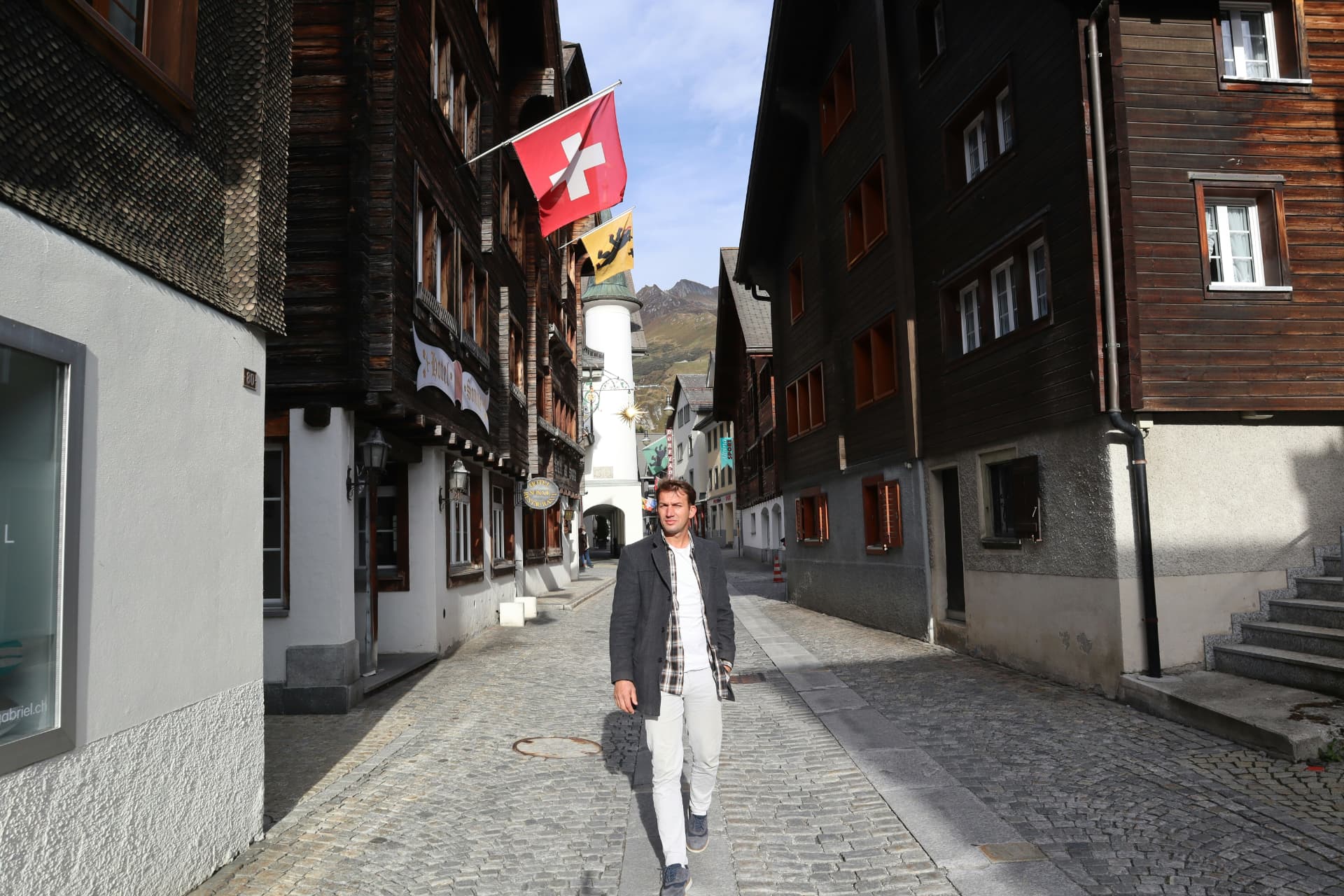
About me
I'm 28, Swiss, and I have a completely ordinary office job. No finance career, no trading desk, no inheritance. Just a normal salary, a savings rate I take seriously, and a spreadsheet I open far too often.
Most of what I know comes from books rather than from anyone selling me something. "Rich Dad Poor Dad" was the one that made me care about money at all, and Gerd Kommer is the author I keep going back to for the boring, useful parts: broad index funds, low costs, and holding on for decades.
The goal is simple. Become financially independent as early as I can and swap the commute for the mountains. Not a yacht, not a Lamborghini. A quiet place at altitude, decent hiking boots, and the freedom to decide how I spend a Tuesday.
That is the only reason fees interest me. Every franc that leaks away in custody charges, currency margins and commissions is a franc that never compounds. This page is just the homework I did. And yes, if you open an account through my invitation link, we both get a small thank-you from Interactive Brokers.
Further reading
Same fees, same account, same broker, plus up to USD 1,000 in IBKR stock for depositing money you were going to invest anyway.
Referral link: ibkr.com/referral/marco1592. The bonus is paid by Interactive Brokers. Using it costs you nothing extra.